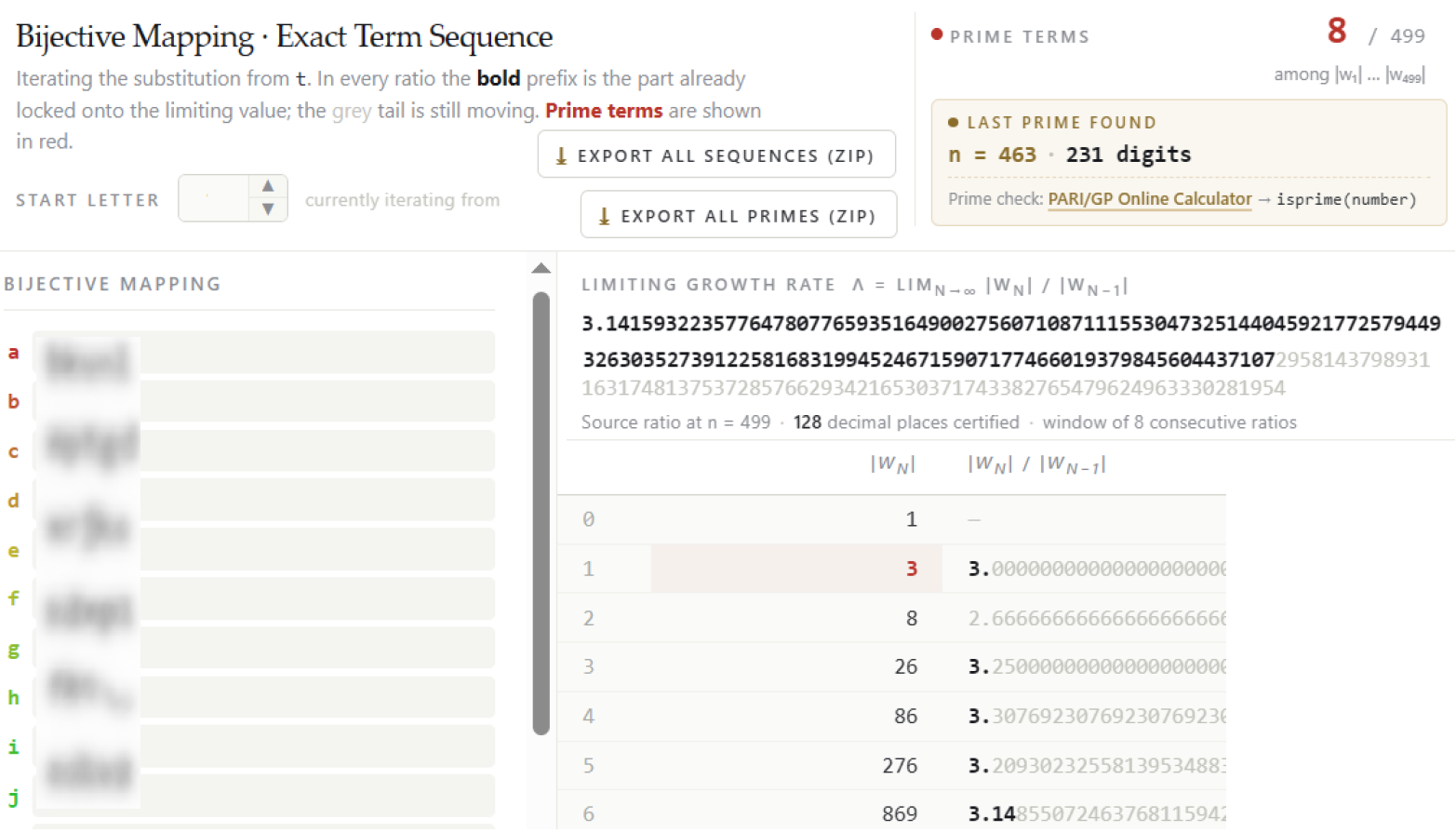
The recursive operator β. Schematic of the deterministic transformation that maps spoken letter names to numerical sequences.
The Engineering of Alphabets (EOA) program investigates a class of deterministic symbolic representations derived from letter-name strings. The research spans symbolic dynamics, representation theory, deterministic systems, and the algebraic structure of phonetic encodings.
EOA is not a learned embedding. It is a structural primitive.
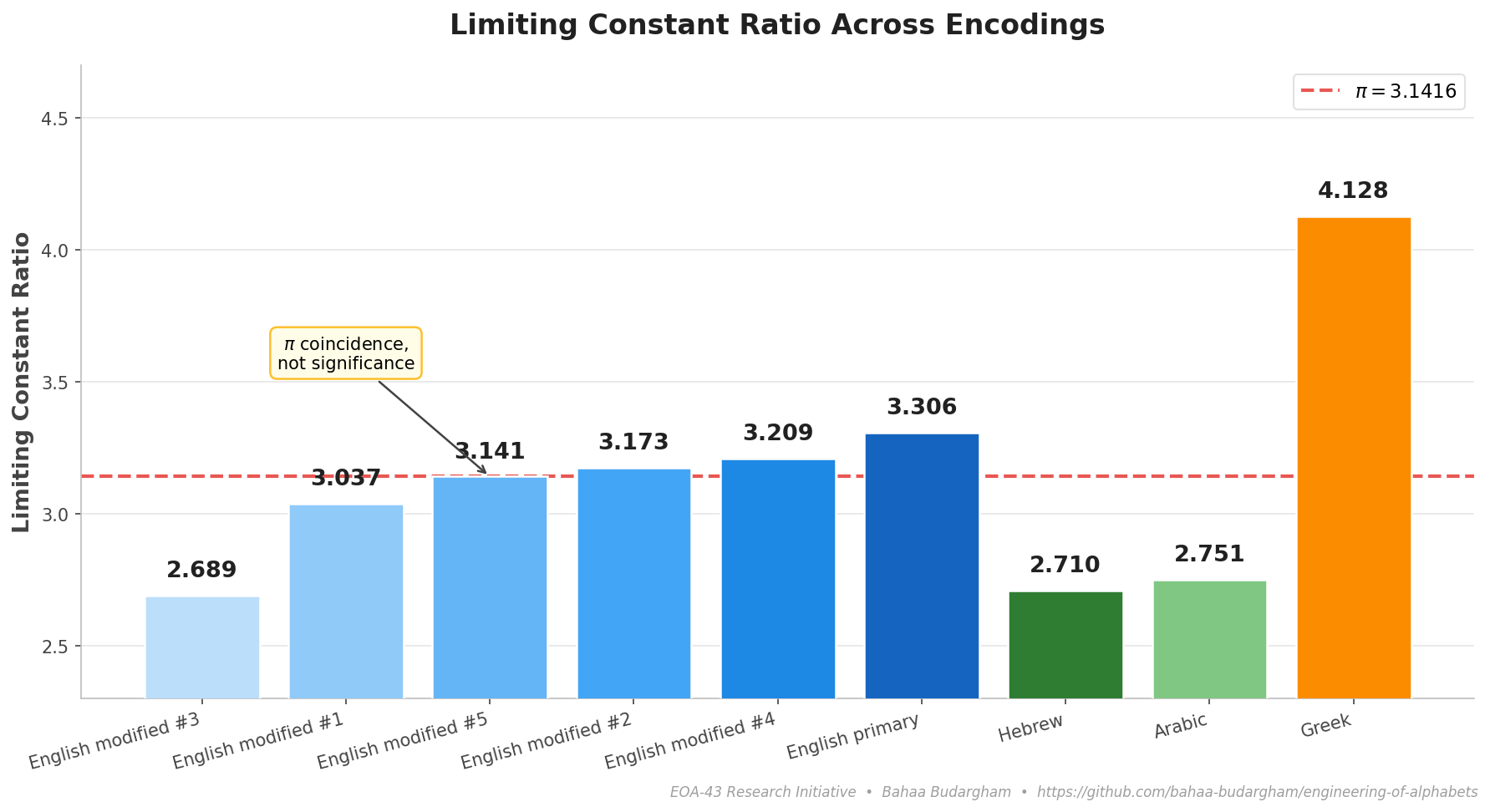
Limiting Constant Ratio (LCR): Encoding-dependent. See table below.
| Encoding | LCR (λ) |
|---|---|
| English primary | 3.306 |
| English modified #1 | 3.037 |
| English modified #2 | 3.173 |
| English modified #3 | 2.689 |
| English modified #4 | 3.209 |
| English modified #5 | 3.141 |
| Arabic | 2.751 |
| Hebrew | 2.710 |
| Greek | 4.128 |
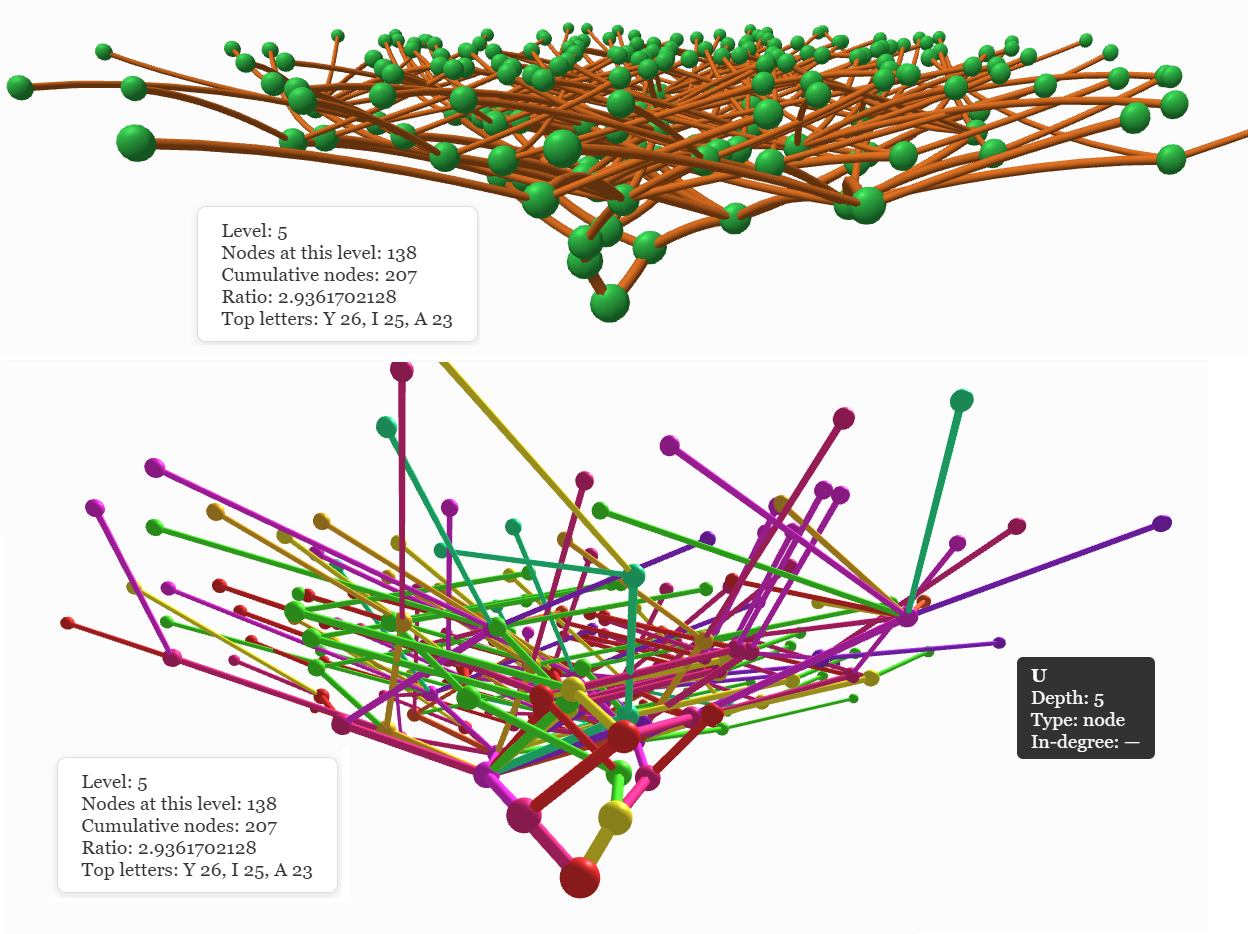
Preliminary visual inspection suggests the generation process forms a recursive, tree-like branching structure. See the Visualizations page for the full set. Two examples:
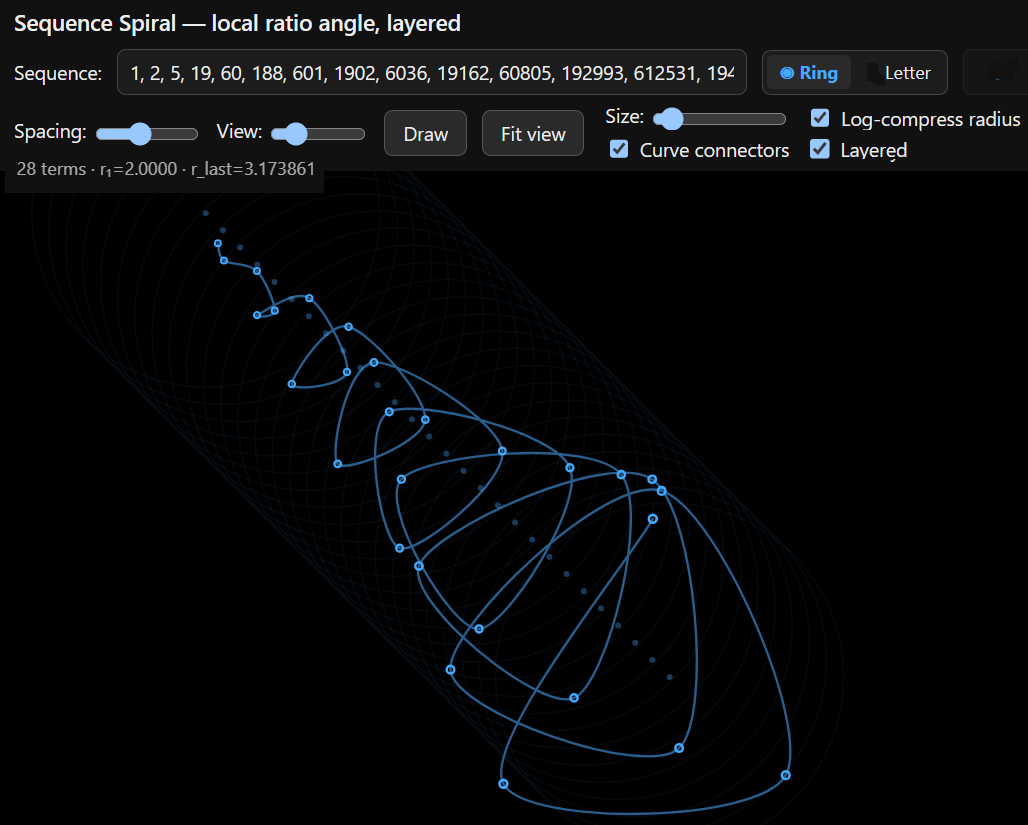
Under English modified #5 (LCR ≈ 3.141), the 20 EOA sequences split into two recurrence families. The larger family has 13 sequences that form a true basis for a 13-dimensional solution space of a common linear recurrence. The generating functions share denominator Q₂(x). The other family has denominator Q₁(x) = (x − 1)Q₂(x). The limiting constant ratio is the reciprocal of the smallest-modulus root of Q₂, and it matches π to five decimal places. The 20 sequences satisfy exactly 6 independent linear relations, spanning a 14-dimensional space.
A tool has been developed to ingest each letter's rational generating function and automatically report shared denominators, shared numerators, and numerator-equals-denominator matches across entries. It also computes pairwise GCDs between denominators and flags letters without a match. Initial results are striking and will be published alongside the full algebraic write-up in Part V.
Read the full algebraic foundation →
| Part | Title | What It Covers |
|---|---|---|
| Part 0 | The Engineering of Alphabets as an Open Frontier | Programmatic overview; poses 43 open questions across 10 domains; introduces the EOA program and its scope. |
| Part I | EOA-43: A Rank-Collapsed Deterministic Word Representation | Presents the 43-term sequence vectors, rank-1 collapse, and the EOA-43 word representation. |
| Part II | Empirical Cross-Encoding Variation of the Limiting Ratio | Documents LCR variation across 7 encodings and 4 languages; explores encoding-dependence. |
| Part III | Transient Structure and Detrended Residuals | Analyzes the letter-specific transient regime (terms 1–38) and what information survives. |
| Part IV | Boundary Mapping on Downstream Tasks | Explores applications in NLP, compression, and adversarial robustness. |
| Part V | The Operator Beta and Its Recurrence Class | Theoretical classification of the operator; formal characterization of the recurrence and the 13-dimensional basis. |
For collaboration or access to restricted materials (sequence vectors, oracle, or operator), please contact:
bdarghamneurolabs(at)gmail.com